When doing research in STEM fields, you will come across many different types of publications and resources. You may have already seen some of the more common types - scholarly journal articles, conference papers, books - but there are also some uncommon ones that can be useful in your research.
Publications can be written for distinct audiences and provide different types of information. Becoming familiar with publication types and when they are produced during the research lifecycle can help you find the information you need faster.
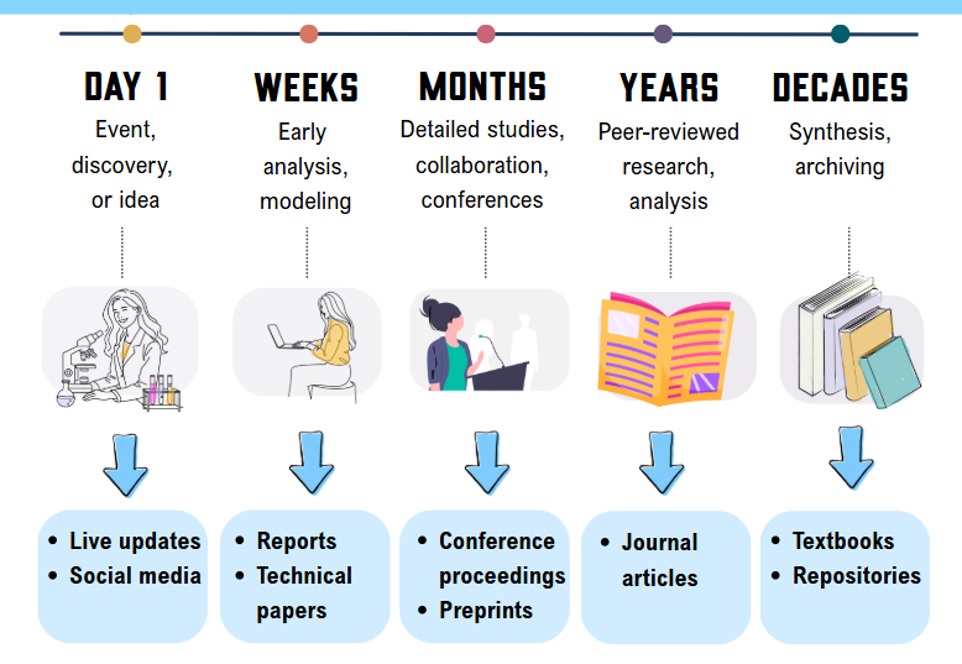
Timeline of research and publication
Scientific publication types often align with an initial event, discovery or idea proposal. Publication proceeds on different timelines with some initial findings being presented over weeks or months, and longer term studies or analysis occurring over years. Ultimately this is also a cyclical process with idea, data and findings reimagined as new information becomes available.
Primary, secondary, and tertiary sources in STEM
The scientific literature is categorized into three main tiers depending on how close the material is to the original research event.
Primary Sources
First-Hand Research
Presents or comments on direct, first-hand research, field data, or laboratory experiments. Highly specialized and current.
Secondary Sources
Synthesis & Overview
Summarizes and synthesizes primary findings. Ideal for gaining a high-level overview of a research domain and locating key citations.
Tertiary Sources
Foundational Facts
Compiles broad, discipline-level background information and well-established scientific facts. Not typically referenced heavily.
Examples of Publication Types by Source
Select a tab below to learn more.
Focus: Original research & raw empirical data
| Format | Definition | Key Characteristics | Limitations |
|---|---|---|---|
| Journal Articles | Detailed reports of original empirical studies or theoretical work | Standardized structure; rigorously peer-reviewed | Publication delays (6–18 months); paywalls; publication bias toward positive results |
| Conference Papers | Works-in-progress presented at scientific conferences | Fast dissemination; crucial for fast-moving fields (e.g., artificial intelligence; computer science) | May lack complete methodology; findings can be preliminary |
| Datasets & GIS Data | Raw or processed observational measurements and spatial data | Machine-readable; published in open repositories | Requires specialized software/code to analyze |
| Technical Reports | Detailed research progress/results for project sponsors | Produced for funding agencies; includes raw technical depth | Hard to locate due to limited distribution; highly specialized |
| Patents | Legal rights give by the government to inventors | Covers function, purpose and process of an invention | Difficult to read; not connected to product names; not peer reviewed |
| Preprints | Openly available research papers posted online, often on preprint servers, before they have undergone peer review | Authors can release ideas without waiting for lengthy peer-review process; a preprint may exist online alongside a final, peer-reviewed journal version | Not peer reviewed; not edited |
Focus: Synthesis, critique, & practical applications
| Format | Definition | Key Characteristics | Limitations |
|---|---|---|---|
| Literature Reviews | Critical evaluation and synthesis of multiple primary papers | Identifies research gaps; offers exhaustive reference lists | Inherently lags behind the newest primary publications |
| Monographs | In-depth books or chapters focused on a specific research area | Broad context and historical trajectory of a niche topic | Takes longer to produce than journal articles |
| Physical Maps | Visual representations of geological or ecological relationships | Reference tool for geology, urban planning, and ecology | Static once printed; limited by scale and resolution |
| Standards | Formal technical specifications and measurement protocols | Authoritative benchmark for safety and quality | Expensive to access; slow consensus updates |
Focus: Broad, foundational background information
| Format | Definition | Key Characteristics | Limitations |
|---|---|---|---|
| Encyclopedias | Broad topic summaries written by domain experts | Great entry point; includes introductory bibliographies | Can quickly become outdated |
| Textbooks | Comprehensive overviews of core discipline concepts | Pedagogy-focused; structured for sequential learning | Ignores recent fringe research or ongoing debates |
| Handbooks | Reference books designed for quick fact-checking | Quick access to physical constants, formulas, and rules | Lacks deep theoretical explanations |
Emerging and Ephemeral Formats
Grey Literature refers to sources produced by organizations where publishing is not the primary activity. Primary sources mentioned above like dissertations, technical reports, and government white papers are grey literature, as are some secondary and tertiary resources. While they often bypass standard peer review, they retain high scientific value.
Modern research, however, increasingly involves ephemeral digital outputs:
Issuer: Stable bodies (e.g., NASA, WHO, universities)
Storage: Archival institutional repositories
Metadata: Standard DOIs, dates, report numbers
Characteristic: Static, finalized documents
Issuer: Individual creators (Substack, Reddit, X/Twitter)
Storage: Self-published or hosted on third-party platforms
Metadata: Inconsistent or missing indexing; high link rot
Characteristic: Dynamic, conversational, iteratively edited
How to Handle Ephemeral Outputs in a Research Paper
| Category | Examples | Characteristics | Citation Guidance |
|---|---|---|---|
| Presentations | Webinars, Lecture Slides | High-value knowledge transfer; dependent on live context | Citable if archived in permanent repositories (e.g., Zenodo) with a DOI |
| Newsletters/Blogs | Substack, Medium | Fast dissemination of expert commentary with high-quality expert commentary; no institutional review | Cite with caution; high risk of post-publication edits |
| Community Threads & Conversations | Reddit, X/Twitter | Real-time collaborative discussion and field sentiment | Cite for qualitative social trends, not factual scientific claims |
| Machine Artifacts | AI Prompts & LLM Outputs | Non-reproducible outputs across runs | Append full prompt and output transcript per style guides (APA/MLA) |
Diversifying your sources
As you work on your research topic, invest some time to consider the variety of sources and representation you cite in your published work. Not only are there multiple types of resources, but there are also multiple perspectives on each topic. Take the time to consider:
What groups or individuals have firsthand experience and knowledge of this topic?
What groups or individuals are impacted by this topic?
Where can I find information that represents a variety of perspectives?
Research indicates that scholars from historically marginalized groups, such as women, and Black, Indigenous, and other scholars of color (BIPoC) are cited less frequently than their white, male counterparts (Dworkin et al., 2020; Kozlowski et al, 2022). However, diversity in who we cite increases the diversity in who is doing research, which increases scientific innovation.
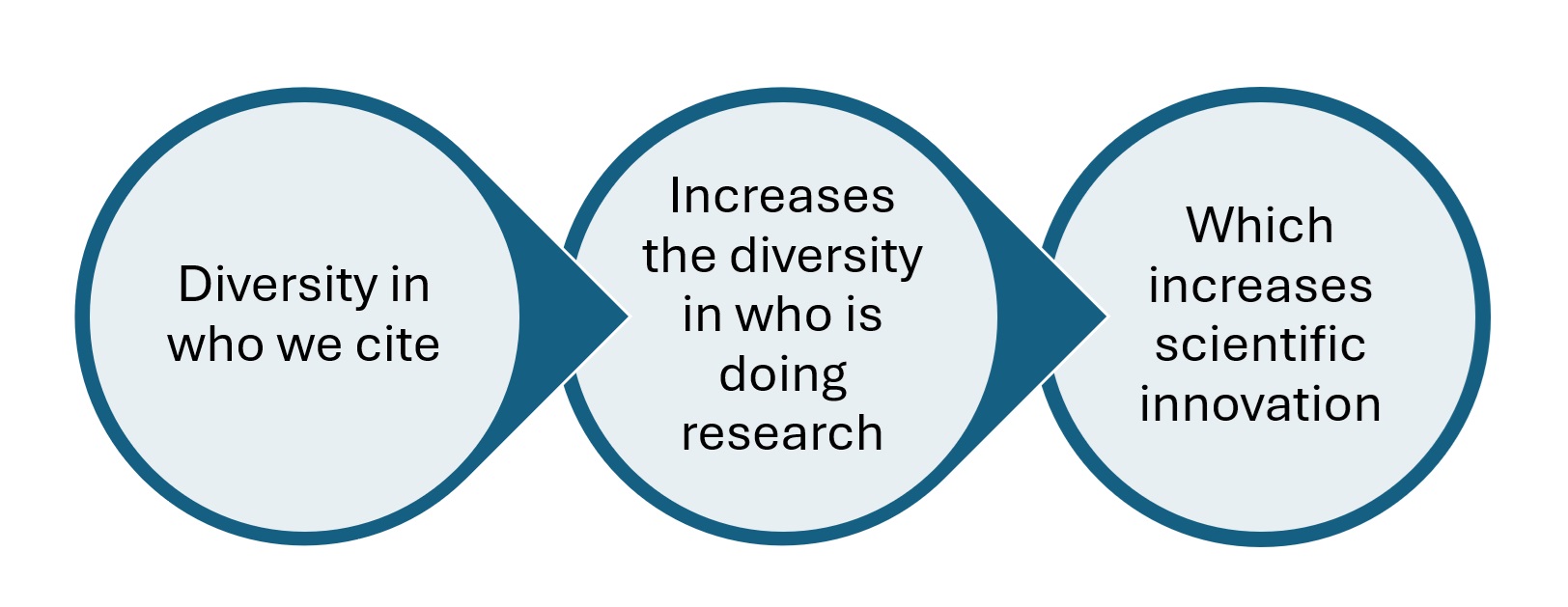
Image credit: Andrea Miller-Nesbitt
Citations assign intellectual value, legitimacy, and authority to scholars and their work. The degree to which a scholar is cited has real-world impacts including hiring, promotion, tenure, and funding opportunities.
The more a source gets cited, the more it will continue to be cited. This effect is intensified by increasing reliance on AI-driven citation analysis. In order to have conversations where diverse perspectives are present, we as individual scholars can critically examine our citations and intentionally ensure a wide variety of voices are represented.
There are many resources to analyze your own citations and diversify the representation in your sources - try them out! Here are a few to get started, and you can explore the links below for additional guidance and ideas.
Take a moment for this thought exercise: Imagine what a room filled with your authors would look like.
Where are the gaps in the research on your topic? What are the main viewpoints on this topic and in this field? What’s missing? How could you include historically marginalized points of view?
Research authors: Who are you citing? Check faculty bio pages, Google Scholar profiles, and other sites online. How do the authors self-identify, and which communities are they engaged with? Who has the author been cited by, and who do they cite?
Seek output from scientific conferences, organizations or databases highlighting scholarly diversity in your disciple. For example, explore this list from McGill Library of interdisciplinary and subject-specific resources, such as: SACNAS Biography Project, Astroindigenous, Diversify Chemistry, National Society of Black Engineers, Indigenous Health Researchers Database, and many more…
Consider other ways of knowing that might not be included in the scholarly conversation, such as those from indigenous communities or traditional ecological knowledge.
Is peer-review always the most useful format for every project? What are some other options and other places to look? For example, primary resources from a member of the relevant community.
Evaluating Resources
Before using any sources in your work, you should be prepared to evaluate its relevancy for your information needs. Consider the following questions for any source:
Authority - Who is the author? What is their point of view?
Purpose - Why was the source created? Who is the intended audience?
Publication & format - Where was it published? In what medium?
Relevance - How is it relevant to your research? What is its scope?
Date of publication - When was it written? Has it been updated?
Documentation - Did they cite their sources? Who did they cite?
For a deeper dive on source evaluation, see our Evaluating Resources Guide.
Assessment
Assess your knowledge by expanding and responding to the questions below.
Knowledge Check 1: Resource types
Match the information need with the publication type where you’re most likely to find the information.
Summary and synthesis of papers published about wildfire risk in wildland-urban interface zones.
Description of an experimental study to optimize fire evacuation routes in Los Angeles County.
Parcel data for homes in the Altadena community of Los Angeles County.
A. Literature reviews
B. Datasets and GIS Data
C. Journal articles
Check Answer
Correct Answer: 1A, 2C, 3B
Explanation:
Literature reviews: provide critical evaluation and synthesis of multiple primary papers.
Journal articles: provide detailed reports of original empirical studies or theoretical work.
Datasets and GIS Data: provide raw or processed observational measurements and spatial data.
Knowledge Check 2: Audiences
Scenario: You have developed a novel machine-learning algorithm that improves early wildfire detection by 35%. You need to communicate findings to three distinct groups. Match the audience with the most appropriate publication type.
Computer science researchers who want to reproduce the model structure.
Emergency management directors who need actionable deployment advice.
The general public interested in local wildfire risk.
A. Policy brief
B. Podcast interview
C. Peer-Reviewed Journal Article
Check Answer
Correct Answer: 1C, 2A, 3B
Explanation:
Computer Science Researchers: Require the full methodological depth of a Peer-Reviewed Journal Article for replication.
Emergency Directors: Require concise, actionable Policy Briefs for deployment.
General Public: Benefit from accessible audio media like a Podcast Interview.
Knowledge Check 3: Evaluation
Which criteria would you not use when evaluating a source for relevancy?
A. Authority
B. Length
C. Purpose
D. Date of publication
E. Documentation
Check Answer
Correct Answer: B
Explanation:
Authority, purpose, date of publication, and documentation should be considered, along with publication & format, when evaluating a source for relevancy. The length of the source does not provide any helpful indication of relevancy.
- Dworkin, J., Zurn, P., & Bassett, D. S. (2020). (In)citing Action to Realize an Equitable Future. Neuron, 106(6), 890–894. 10.1016/j.neuron.2020.05.011
- MacLeod, L. (2021). More Than Personal Communication: Templates For Citing Indigenous Elders and Knowledge Keepers. KULA: Knowledge Creation, Dissemination, and Preservation Studies, 5(1). 10.18357/kula.135